November 1, 2026 – the 22nd day of the ninth lunar month in the Tibetan calendar
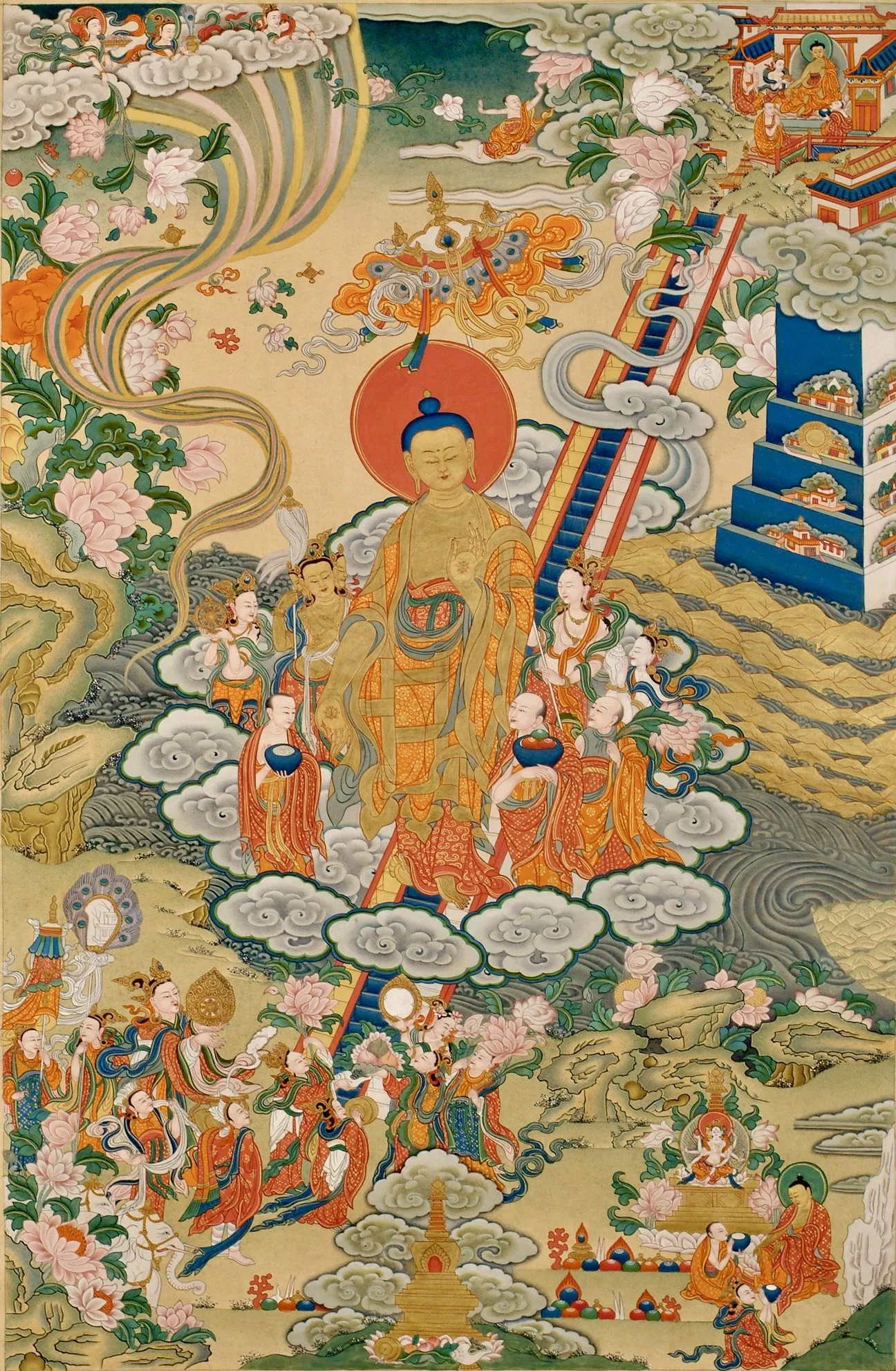
Each autumn, Buddhists around the world celebrate Lhabab Düchen, one of the four great festivals commemorating pivotal events in the life of Shakyamuni Buddha. This sacred day honors the Buddha's descent from the celestial realm of the Thirty-Three (Trāyastriṃśa), where he had traveled to offer teachings to his mother and the celestial beings who gathered there.
The story of Lhabab Düchen is one of profound gratitude and boundless compassion. It reminds us that the path of awakening does not lead us away from the world and its suffering but opens our hearts to engage with it more fully.
The Buddha's Return to Earth
Seven days after giving birth to Prince Siddhartha, Queen Māyā passed away and was reborn in the celestial realms. Many years later, after attaining enlightenment, the Buddha wished to repay his mother's kindness by offering her the precious gift of the Dharma.
He traveled to Trāyastriṃśa Heaven, where he taught the Abhidharma, profound teachings illuminating the nature of mind and reality. His mother came to receive these teachings, along with countless celestial beings who were inspired toward liberation.
After several months, the Buddha's disciples on Earth began to long for his return. The great disciple Maudgalyāyana ascended to the celestial realm and respectfully requested that the Buddha return to continue guiding beings in the human world.
The Buddha agreed. On the 22nd day of the ninth lunar month, he descended to Earth upon a magnificent, jeweled ladder, accompanied by Indra and Brahmā, who descended on ladders of gold and silver. His return was celebrated by beings throughout the realms of existence.
This extraordinary event, known as Lhabab Düchen, or "the great occasion of the descent from heaven," reminds us that the Buddha's activity is continually directed toward the liberation of beings. His ascent was an expression of gratitude and compassion, and his return reflected that same boundless commitment.
When Gratitude Becomes Compassionate Action
There is something especially moving about the Buddha's wish to repay his mother's kindness. Although he had attained complete awakening, he did not regard his own liberation as the completion of his relationship with others. Rather, his realization found expression in the wish to benefit those who had cared for him, and ultimately all beings.
This points to an essential teaching of the Mahayana path. None of us has arrived at this moment through our own efforts alone. Our lives have been sustained by the kindness, generosity, and contributions of countless beings, many of whom we will never know. The food we eat, the knowledge we receive, the communities that support us, and even the opportunities we have to practice the Dharma arise through our interdependence with others.
As we recognize this more deeply, gratitude becomes more than appreciation for what we have received. It can awaken a heartfelt wish to respond to that kindness by contributing to the well-being of others. This is one of the foundations of bodhicitta, the awakened heart that aspires to attain awakening for the benefit of all beings. Gratitude opens our hearts to the kindness we have received. Bodhicitta expands that openness into the aspiration to become a source of benefit for others.
Returning to the World: The Bodhisattva's Commitment
The Buddha's descent from the celestial realm offers a profound image of the bodhisattva's commitment.
Awakening is not an escape from the world. Nor does the unveiling of innate wisdom and compassion require us to turn away from the suffering and uncertainty that are part of human existence. Rather, the more deeply we understand the nature of reality, the more freely and compassionately we can engage with the conditions of our lives.
This is particularly meaningful in our present world. We are living through times marked by polarization, war and violence, environmental crises, economic upheaval, and growing fear and isolation. In the face of so much suffering, it is understandable that we may sometimes feel overwhelmed, discouraged, or powerless to make a difference.
We may be tempted to withdraw, to protect ourselves by turning away, or to believe that our individual efforts cannot meaningfully affect the larger world. Yet the bodhisattva path offers another possibility.
At the heart of this path is the understanding that all things arise through interdependence. Nothing exists in isolation, and no person, circumstance, or experience possesses an independently existent essence. Far from suggesting that nothing matters, this understanding of emptiness reveals that because everything arises through causes and conditions, change is possible.
This has profound implications for how we engage with the world. When we regard difficult circumstances as solid and unchangeable, we can easily become discouraged or overwhelmed. But when we recognize their interdependent and empty nature, we begin to see that even deeply entrenched patterns of suffering can shift. Our actions, however small, can contribute to the causes and conditions that support beneficial change.
At the same time, wisdom helps us release our attachment to particular outcomes. We can act wholeheartedly to relieve suffering without believing that we must control the results of our efforts. We can remain committed even when change is slow, uncertain, or beyond our ability to perceive. This is not indifference or resignation. It is the freedom to engage fully without being consumed by the difficulties we encounter.
Through meditation and the cultivation of wisdom, we gradually develop greater stability and clarity, allowing us to recognize our habitual reactions without being governed by them. We can learn to meet anger without inflaming anger, fear without deepening fear, and suffering without losing our capacity for compassion. As our minds become less dominated by reactivity, we gain greater freedom to discern what is beneficial and to respond with courage, wisdom, and care.
The bodhisattva's commitment is not dependent upon the promise that our efforts will succeed or that the world will unfold according to our wishes. It rests upon a deep recognition of the suffering of others, an understanding that our actions have an impact, and the confidence that each moment offers an opportunity to contribute to the well-being of others.
Bringing the Dharma into Everyday Life
The Buddha's return to Earth reminds us that the Dharma is meant to be lived. Our meditation practice is not separate from our relationships, our communities, or our responsibilities in the world. The qualities we cultivate on the meditation cushion are precisely those we are learning to bring into the circumstances of everyday life.
Sometimes compassionate engagement calls for courageous action in response to injustice or suffering. At other times, it takes the form of listening patiently, offering practical support, speaking with kindness, or remaining present with someone who is struggling. It may mean engaging respectfully with someone whose views differ from our own, caring for the natural world, or contributing our time and resources to those in need.
Not every act of compassion will be visible or extraordinary. Yet even the smallest beneficial action contributes to the causes and conditions through which greater well-being becomes possible.
And importantly, we need not wait until our practice is perfected before we begin. We practice in the midst of our lives, learning through our successes and difficulties alike. Each time we recognize that we have become caught in reactivity and choose to return to compassion, we strengthen our capacity to embody the Dharma. In this way, our engagement with the world becomes part of the path itself.
Honoring Lhabab Düchen
Lhabab Düchen is traditionally regarded as a particularly auspicious day for Dharma practice, when the karmic effects of beneficial and harmful actions are said to be greatly multiplied. It is an opportunity to renew our commitment to awakening and to bring special awareness to the ways we express that commitment through our thoughts, words, and actions.
We can honor this sacred day by:
Making offerings of candles, flowers, food, or incense on our shrine.
Dedicating additional time to meditation, prayer, and the cultivation of bodhicitta.
Reflecting with gratitude upon the kindness of our parents, teachers, loved ones, and all those who have contributed to our lives.
Practicing generosity and engaging in acts of service that relieve suffering or bring benefit to others.
Cultivating the Six Pāramitās of generosity, ethical discipline, patience, joyous effort, concentration, and wisdom.
Dedicating the merit of our practice and beneficial actions to the awakening and well-being of all beings.
As we celebrate Lhabab Düchen, we can reflect upon the Buddha's extraordinary journey, undertaken first to repay his mother's kindness and then to return to the world to continue guiding beings toward liberation. His descent reminds us that the path of awakening does not lead us away from this world but opens our hearts more fully to it.
May the wisdom and compassion we cultivate find expression in the ways we meet one another, respond to suffering, and contribute to the well-being of all beings. And may we remember that even in times of great turbulence, our capacity to act with wisdom, courage, and compassion is itself a source of strength.