About Us

Welcome to Sukhasiddhi Foundation
Sukhasiddhi Foundation offers an extraordinary opportunity to go directly and deeply into the heart of the rich and ancient practices of Tibetan Buddhism in an atmosphere that supports, enlivens and radically changes our daily lives.
The lineages of Tibetan Buddhism offer an unbroken stream of blessings from the Buddha down to us, enables us to practice very deeply while in the midst of our everyday experience. The traditional Vajrayana and Mahamudra meditations of Tibet are intended to create rapid transformation of our minds and hearts so that wise action, compassion and loving kindness can open and flourish within us. Vajrayana practices help us to transform our ordinary experiences, which are marked by suffering, into the awakened experience of reality as the union of bliss and emptiness.
The Mahamudra meditative practices focus on the realization of the true nature of mind and real-ity—the inseparability of clarity, luminosity and openness—an experience that is available to us in every moment. These teachings are offered through meditation sessions, classes, programs and retreats under the guidance of Lama Döndrup and a council of highly experienced and trained lamas and dharma leaders. At Sukhasiddhi, we stress the vital importance of integrating psychological growth and spiritual practice so that we do not short circuit the process of becoming fully human and do not relegate spiritual practice to some isolated corner of our lives.
Our practice should empower us and unwind unhealthy habitual patterns so that our lives become meaningful, and our actions are in accord with our deepest truth. We strongly believe that we each hold within us the deep guidance that we need in order to realize our true nature, and we encourage students to rely on themselves and learn to listen to their own inner guru. In this way the practices flourish in a non-authoritarian environment in which sangha members offer each other support, respect and friendship. We look forward to your participation.
Lama Döndrup, Sukhasiddhi Resident Lama

Our Mission
To share the Buddha’s teachings with everyone, to provide an environment for people to recognize their innate wisdom and compassion and embody it in all aspects of daily life.
Our Vision
To create an equitable community of diverse people that supports one another on the path of recognizing and actualizing their awakened nature individually, and as a community, to foster cooperation among our whole human family and benefit all beings.
Sukhasiddhi Foundation offers a range of meditation, classes, retreats, and study programs for people at all levels. Our emphasis is on the cultivation of both wisdom and love. The teachings help develop each individual’s full and complete potential through engagement with meditation, Tibetan yoga, and other spiritual practices. Students are supported to unwind the unhealthy habitual patterns that block us from recognizing and appreciating the radiant true nature of reality and ourselves, leading to the flowering of creativity and unique potential.

The teachings are given in a loving and joyful environment in which teachers and community members offer each other respect, support and friendship.
Our Core Values:
Honoring the feminine principles of openness, relatedness, peace, harmony, natural unfolding, embracing, nourishing, unconditional love, and wisdom;
Embracing the masculine principles of clarity, one-pointed concentration, grounded strength, skillful activity, organizing, discernment, and creativity;
Bringing the inner feminine and masculine principles into harmony, fruition, and union. Integrating spirit, psyche, and body and integrating practice with everyday life;
Practicing being a good world citizen by: caring for our mother earth, ourselves, and each other; honoring the equality of all beings; practicing generosity towards all beings; and acting with integrity, truthfulness, and honesty;
Facilitating the unwinding and releasing of unhealthy habitual patterns, as well as taking responsibility for our own body, speech, and mind;
Developing courage, self-reliance, confidence and flexibility;
Facilitating the bringing to consciousness each individual’s own innate wisdom; and
Cultivating a conscious spiritual community within an environment of support, friendship, and mutual respect that encourages open, direct and loving communication, and enhances compassion, loving kindness, fulfillment, gratitude and joy.
Organization History and Commencement Date
Sukhasiddhi Foundation was founded by Lama Palden (Caroline Alioto) in 1996 in Marin County, California. Lama Palden was one of the first western women to complete the traditional Vajryana 3-year retreat and was authorized by Kalu Rinpoche to teach as a lama in 1985. After teaching in various centers with Kalu Rinpoche’s blessing, she decided to start her own center to ensure a safe, welcoming place for students, teaching the traditional texts with a more western approach.
Sukhasiddhi Foundation attracted students with significant background in other spiritual disciplines, and within a few years Lama Palden was teaching both a three-year retreat for her most dedicated students and started the first multi-year program for those who wanted more advanced teachings applicable in the context of daily living. Sukhasiddhi grew rapidly and continued its focus on multi-year programs for in-depth study, training 3 more teachers.
After teaching Sukhasiddhi classes, retreats, and programs as well as leading pilgrimages to Bhutan and India for 23 years, Lama Palden stepped down as Resident Lama in Fall 2019 and assumed the position of Senior Lama, focusing on the most advanced students. Lama Döndrup (Jennifer Grant), who completed a 3-year retreat under Lama Palden’s guidance, then stepped into the Resident Lama role and has continued to develop and teach classes, programs of study, and retreats. Sukhasiddhi gave up its physical center during the pandemic and has been offering meditations virtually, attracting students worldwide. A physical center is now being sought, but we will continue offering teachings online.

Lama Palden, Senior Lama
approx. 2003
“Each person, at the core of who we truly are, is a unique, beautiful awake being. But this reality is generally obscured to us, we don’t feel it directly. So the path of dharma is to uncover our innate intelligence innate wisdom, the innate joy, beauty and compassion that is at the core of who we really are.”
- Lama Palden Drolma
THE SHANGPA and KAGYU LINEAGES
Sukhasiddhi Foundation is a center for the study and practice of both the Shangpa and Kagyu lineages of Tibetan Buddhism. From the Buddha down to our current day, the teachings and practices of these lineages have been personally actualized and then transmitted and taught from master to disciple. The masters have mentored their students in this personal, yet universal process. We are very fortunate that in both of these lineages in each successive generation practitioners have actualized awakening and have transmitted the teachings and meditation practices and mentored the next generation. In this way the teachings and lineage have remained vital and unbroken.
Lama Palden Drolma received both the Shangpa and Kagyu lineage transmissions, including empowerments, teachings and personal guidance from her root guru, Kalu Rinpoche, then primary lineage holder of the Shangpa lineage, and a lineage holder in the Kagyu. She also received the profound blessing and many transmissions from the 16th Karmapa, primary holder of the Kagyu Lineage. She then engaged in a three year meditation retreat. Lama Dondrup also completed a three year retreat. Lama Annik and Lama Pat, completed the equivalent of meditation and philosophical in daily life. The entirety of the Shangpa practices are taught as part of the long-term practice programs at Sukhasiddhi Foundation, as well as some of the Kagyu meditations.
The Shangpa lineage was founded by Khyungpo Naljor, an 11-12th c. Tibetan who traveled several times to India to study with Vajrayana Buddhist gurus. He had 150 teachers. His four main gurus were Niguma, Sukhasiddhi, Rahula and Métripa. In Tibet, his teachings became the Shangpa lineage.
One of the most unique and important aspects of the lineage is that most of the practices and teachings in the Shangpa come from two fully and completely awakened women masters: Sukhasiddhi and Niguma. These were Khyungpo Naljorhis primary teachers gurus.
The Karma Kagyu Lineage Masters
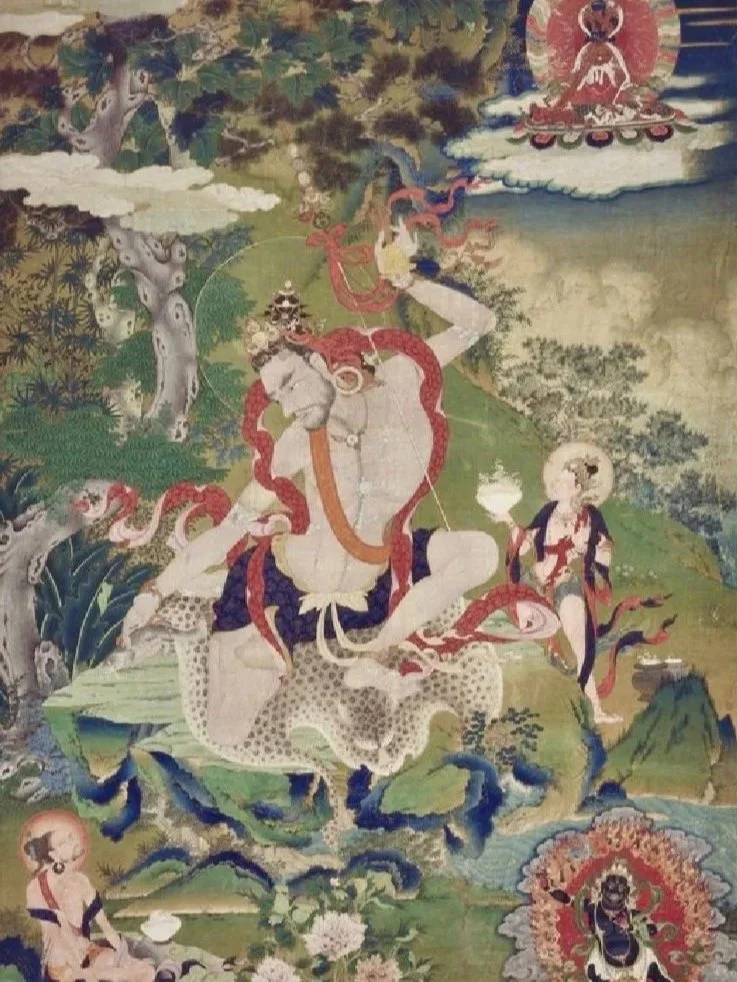
TILOPA (988-1069)
The human founder of the Kagyu school is Tilopa. He meditated unceasingly in the deep jungles of India and is one of the most celebrated of the Indian mahasiddhas. Through tantric mastery, he met the Buddha in his primordial form as Vajradhara (Dorje Chang) and is known to be the first human to receive the Mahamudra teachings. As a teacher, he taught through inspired poetry as he sung about his experiences of realization. His primary disciple was Naropa.

NAROPA (1016-1100)
Naropa was a great scholar at the Buddhist University at Nalanda but, after being visited by a dakini who told him that he “understood the words, but not the meaning” of the Dharma, he abandoned his studies and position to search for the teacher Tilopa. While studying with great trust and devotion to Tilopa, he overcame a series of hardships which cleared obstacles on his path allowing him to attain enlightenment. Naropa is one of the renowned 84 Indian mahasiddhas and is best known for his own unique expression of wisdom, the consolidation of the completion stage teachings into what are known as the Six Yogas of Naropa.

MARPA (1012 - 1096)
Marpa was born in southern Tibet, traveled to India to receive teachings from the great Indian masters. Naropa became his primary teacher and gave Marpa the full transmission of the lineage, declaring Marpa to be his successor. Marpa brought the Kagyu Lineage teachings back to Tibet and spent many years translating these Buddhist scriptures. This was a major a contribution to the transmission of the complete buddhadharma to Tibet. Thus, he is often known as Marpa, the translator.
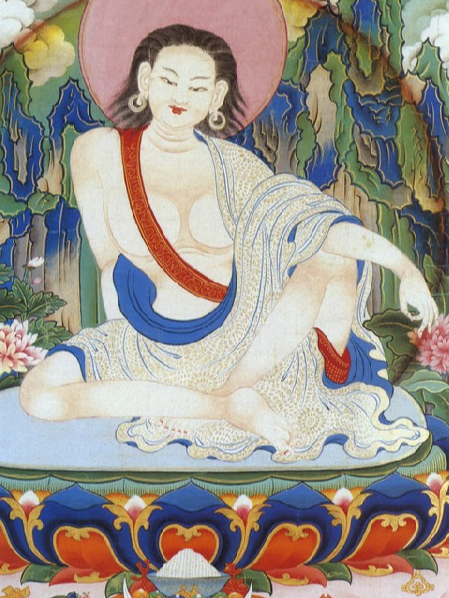
MILAREPA (1052-1135)
Milarepa was born in western Tibet to a prosperous family in the late 11th century. He is best known for sharing his teachings through his acclaimed spiritual poetry known as The Hundred Thousand Songs of Milarepa. The spiritual groundwork he laid for those who came after him illustrates some of the fundamental aspects of the Vajrayana and Mahayana traditions. The spiritual groundwork he laid for those who came after him illustrates some of the fundamental aspects of the Vajrayana and Mahayana traditions.
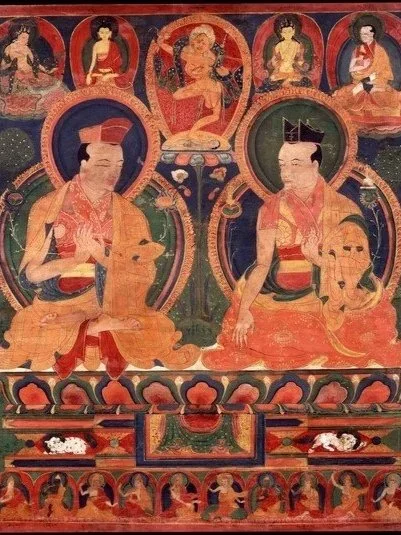
GAMPOPA (1084-1161)
Gampopa lived in Tibet from 1084-1161. From a young age, he studied medicine and, at age 25, he set forth on the monastic path after his wife and children died in an epidemic. While ordained in the Kadam tradition he heard some beggars speak of the renowned master Milarepa, and profound devotion arose in his heart. He sought out Milarepa and became one of his primary students. After many years in meditation retreat, he brought together the tantric teachings and practices of Indian Mahasiddhas with the those of the Kadam monastic tradition. He also brought together the Kadam Lamrim teachings (Stages of the Path to Enlightenment) and the Mahamudra teachings that he received from Milarepa. He founded the Kagyu tradition and wrote the Kagyu version of the Lamrim, Jewel Ornament of Liberation.